Friday, January 7, 2022

Thursday, January 6, 2022
The Epiphany of Our Lord Jesus Christ
The Epiphany
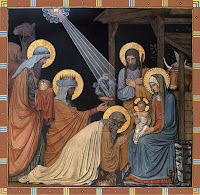
O God, by the leading of a star you manifested your only Son to the peoples of the earth: Lead us, who know you now by faith, to your presence, where we may see your glory face to face; through Jesus Christ our Lord, who lives and reigns with you and the Holy Spirit, one God, now and for ever. Amen.
Today is the Epiphany or the manifestation of Christ to the peoples of the earth. The winter solstice was kept on Jan. 6 at some places during the first centuries of the Christian Era. In opposition to pagan festivals, Christians chose this day to celebrate the various manifestations, or "epiphanies," of Jesus' divinity. These showings of his divinity included his birth, the coming of the Magi, his baptism, and the Wedding at Cana where he miraculously changed water into wine. The day was called "The Feast of Lights." Celebration of the Son of God replaced celebration of the sun. Baptisms were done, and a season of preparation was instituted. It was later called Advent.
The solstice was kept on Dec. 25 by the fourth century. Jesus' birth was celebrated on this day in both eastern and western churches. The western church commemorated the coming of the Magi on Jan. 6. The eastern church continued to celebrate the Baptism of our Lord and the Wedding at Cana on Jan. 6. In the east the day was called "Theophany" (manifestation of God).
The coming of the Magi is celebrated on the Feast of the Epiphany, January 6, in the BCP. The Baptism of our Lord is celebrated on the First Sunday after the Epiphany. *
Join us tonight, Thursday night, January 6, for Zoom Evening Prayer to celebrate and learn a bit more about the Epiphany. Evening Prayer begins at 5:30 p.m. and a time to chat follows.
Zoom Evening Prayer & Epiphany Talk
Wednesday, 5:30 p.m.
Join Zoom Meeting
https://us02web.zoom.us/j/86781577595?pwd=VjNnZTZnUFFadkJPc3VOVTh3K21Idz09
Meeting ID: 867 8157 7595
Passcode: 530
Dial by your location +1 312 626 6799 or +1 346 248 779
* An Episcopal Dictionary of the Church, https://www.episcopalchurch.org/glossary/

Wednesday, January 5, 2022
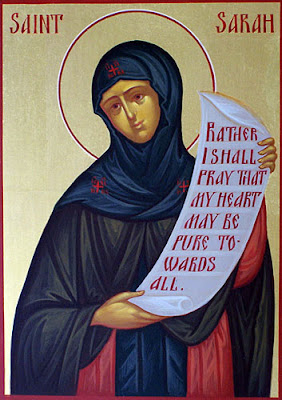
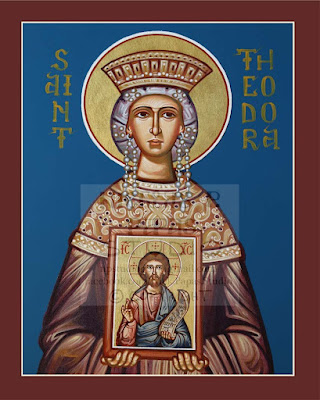
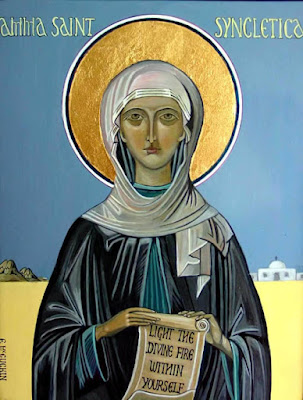
January 5 - Feast of Sarah, Theodora, and Syncletica
Tonight - Zoom Evening Prayer & Desert Mothers Video Class
Join us tonight, Wednesday night, January 5, for Zoom Evening Prayer and our Desert Mothers Video Class. Evening Prayer begins at 5:30 p.m. and our class follows. We will remember "Ammas" Sarah, Theodora, and Syncletica, whose feast is today.
Zoom Evening Prayer & Desert Mothers Video Class
Wednesday, 5:30 p.m.
Wednesday, 5:30 p.m.
Meeting ID: 867 8157 7595
Passcode: 530
Dial by your location +1 312 626 6799 or +1 346 248 779
Passcode: 530
Dial by your location +1 312 626 6799 or +1 346 248 779
More information follows along with Icons of each of these Holy Women.
Sarah, Theodora, and Syncletica of Egypt, Desert Mothers, 4th-5th century
The Collect:
Fix our hearts on You, O God, in pure devotion, that aided by the example of your servants Sarah, Theodora, and Syncletica, the vain pursuits of this world may have no hold upon us, and that by the consuming fire of your Spirit, we may be changed into the image and likeness of your Son, Jesus Christ our Lord; to whom with you and the same Spirit be all honor and glory, now and for ever. Amen.
The Desert Mothers were female Christian ascetics living in the desert of Egypt, Palestine, and Syria in the 4th and 5th centuries AD. They typically lived in the monastic communities that began forming during that time, though sometimes they lived as hermits. Other women from that era who influenced the early ascetic or monastic tradition while living outside the desert are also described as Desert Mothers.
The Desert Fathers are much more well known because most of the early lives of the saints "were written by men for a male monastic audience" — the occasional stories about the Desert Mothers come from the early Desert Fathers and their biographers. Many desert women had leadership roles within the Christian community. There are several chapters dedicated to the Desert Mothers in the Lausiac History by Palladius, who mentions 2,975 women living in the desert. Other sources include the various stories told over the years about the lives of saints of that era, traditionally called vitae ("life"). The lives of twelve female desert saints are described in Book I of Vitae Patrum (Lives of the Fathers).
The Desert Mothers were known as ammas ("spiritual mothers"), comparable to the Desert Fathers (abbas), due to the respect they earned as spiritual teachers and directors. One of the most well known Desert Mothers was Amma Syncletica of Alexandria, who had twenty-seven sayings attributed to her in the Apophthegmata Patrum, or Sayings of the Desert Fathers. Two other ammas, Theodora of Alexandria and Amma Sarah of the Desert, also had sayings in that book.
According to written accounts, Amma Syncletica might have been born around AD 270 (since she died about AD 350 and is said to have lived to her eighties), to wealthy parents in Alexandria and was well educated, including an early study of the writings of Desert Father Evagrius Ponticus. After the death of her parents, she sold everything she had and gave the money to the poor. Moving outside the city with her blind sister, she lived as a hermit among the tombs outside of Alexandria. Gradually a community of women ascetics grew up around her, who she served as their spiritual mother. Even though she was an ascetic and hermit, Syncletica taught moderation, and that asceticism was not an end in itself.
Theodora of Alexandria was the amma of a monastic community of women near Alexandria. Prior to that, she had fled to the desert disguised as a man and joined a community of monks. She was sought out by many of the Desert Fathers for advice—reportedly Bishop Theophilus of Alexandria came to her for counsel.
Sarah of the Desert's sayings indicate that she was a hermit living by a river for sixty years. Her sharp replies to some of the old men who challenged her show a distinctly strong personality. According to one story, two male anchorites visited her in the desert and decided, "Let's humiliate this old woman." They said to her, "Be careful not to become conceited thinking to yourself: "Look how anchorites are coming to see me, a mere woman." She replied, "According to nature I am a woman, but not according to my thoughts." *
* Wikipedia, via The Lectionary, http://www.satucket.com/lectionary/desert_mothers.html
Tuesday, January 4, 2022
Elizabeth Ann Seton
Elizabeth Ann Seton, Vowed Religious and Educator, 1821
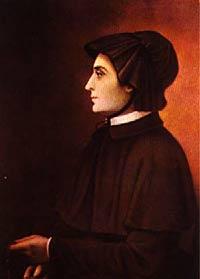
Give us grace, O God, to love you in all things and above all things, that following the example of your servant Elizabeth Ann Seton we might express our love for you in the service of others. Through Jesus Christ our Lord, who lives and reigns with you and the Holy Spirit, one God, in glory everlasting. Amen.
Elizabeth Ann Bayley Seton (August 28, 1774 — January 4, 1821) was the first native-born citizen of the United States to be canonized in the Roman Catholic Church, on September 14, 1975.
Seton was born on August 28, 1774 to Richard Bayley of New York City. She was raised in the Episcopal Church. Her mother, daughter of an Episcopal priest, died when Elizabeth was three. At the age of nineteen, she married William Magee Seton, a wealthy businessman. Five children were born to the marriage.
Her husband's business lost several ships at sea and the family ended up bankrupt. Soon after, her husband became ill and his doctors sent him to Italy for the warmer climate, with Elizabeth Seton accompanying him. In Italy, they were held in quarantine, during which time her husband died. She spent time with a wealthy family where she was exposed to Catholicism. Two years later she converted to Roman Catholicism, on March 14, 1805 and was received into the Church by the first bishop of Baltimore, John Carroll.
To support her children, she started a school in Baltimore, but it failed due to the anti-Catholic bigotry of the day. In 1809, after some trying and difficult years, Elizabeth moved to Emmitsburg, Maryland, where a year later she established Saint Joseph's Academy and Free School, a school dedicated to the education of Catholic girls, at the invitation of Samuel Sutherland Cooper.
Eventually, Elizabeth was able to establish a religious community in Emmitsburg, Maryland dedicated to the care of the children of the poor. It was the first religious community of apostolic women founded in the United States. The order was called the Sisters of Charity of St. Joseph.
The remainder of Elizabeth's life was spent in leading and developing the new order, which expanded to include the Sulpician priests of Baltimore. Today, six independent religious communities trace their roots to the humble beginnings of the Sisters of Charity in Emmitsburg, Maryland. *
* Wikipedia, via The Lectionary, http://www.satucket.com/lectionary/elizabeth_seton.htm
Monday, January 3, 2022

Saturday, January 1, 2022
This Sunday

Sunday, January 2, 2022
Join us for “at church” or “virtually” for worship this Sunday, January 2, The Second Sunday after Christmas, at St. Alban’s, St. Thomas’, St. Patrick’s, and Iglesia Episcopal La Esperanza de Familias Unidas. Remember - Masks are optional for all, and communion will be offered in both kinds- wine by intinction. We strongly urge everyone to get vaccinated. Please maintain social distance in non-family groups.
Holy Eucharist, Rite Two
St. Alban’s - 8:30 a.m. and 10:30 a.m.*
St. Thomas' - 10:00 a.m.*
St. Patrick’s – 11:00 a.m.*
* These liturgies will be Live-Streamed on Facebook for those who choose to remain at home. Download a pdf of the leaflet to print or to use on your phone or tablet with this link - https://drive.google.com/file/d/12O7pO08JbqJkNp1FSUJP7JpyCH0CA1we/view?usp=sharing
La Santa Eucaristía: Rito Dos en la iglesia (primer y tercer domingo del mes y transmitido en vivo en Facebook) o Oración de la tarde diaria a través de Zoom (los otros domingos del mes)
La Santa Eucaristía - Iglesia Episcopal La Esperanza de Familias Unidas - Domingo - 5:00 p.m.
Zoom Compline - All Welcome
Sunday - 8:00 p.m.
Join Zoom Meeting
https://us02web.zoom.us/j/83861688528?pwd=WFdBcndxV3hzbUpETDNTSFFzc3Z0QT09
Meeting ID: 838 6168 8528
Passcode: 800
or dial in at +1 312 626 6799 or +1 346 248 7799
We hope to “see” you all on Sunday as you are most comfortable!
Rita+, Rob+ and Whit+
Art from Clip Art, Steve Erspamer, Liturgy Training Publications – ltp.org
Zoom Compline - All Welcome
Sunday - 8:00 p.m.
Join Zoom Meeting
https://us02web.zoom.us/j/83861688528?pwd=WFdBcndxV3hzbUpETDNTSFFzc3Z0QT09
Meeting ID: 838 6168 8528
Passcode: 800
or dial in at +1 312 626 6799 or +1 346 248 7799
We hope to “see” you all on Sunday as you are most comfortable!
Rita+, Rob+ and Whit+
Art from Clip Art, Steve Erspamer, Liturgy Training Publications – ltp.org
The Holy Name of our Lord
The Holy Name of our Lord or The Circumcision of Christ

Eternal Father, you gave to your incarnate Son the holy name of Jesus to be the sign of our salvation: Plant in every heart, we pray, the love of him who is the Savior of the world, our Lord Jesus Christ; who lives and reigns with you and the Holy Spirit, one God, in glory everlasting. Amen.
On January 1st, we celebrate the Circumcision of Christ. Since we are more squeamish than our ancestors, modern calendars often list it as the feast of the Holy Name of Jesus, but the other emphasis is the older. Every Jewish boy was circumcised (and formally named) on the eighth day of his life, and so, one week after Christmas, we celebrate the occasion when Our Lord first shed His blood for us. It is a fit close for a week of martyrs, and reminds us that to suffer for Christ is to suffer with Him. *
* The Lectionary, James Kiefer, http://www.satucket.com/lectionary/Holy_Name.htm
Subscribe to:
Posts (Atom)