Friday, February 11, 2022

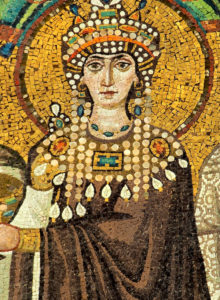
Theodora

Theodora, Empress, c.867

The Collect:

O God, who called your servant Theodora to an earthly throne that she might advance your heavenly kingdom and who gave her the wisdom to establish unity where there had been division; Create in your church such godly union and concord that we might proclaim the Gospel of the Prince of Peace, not only in correct theology but in right actions. All this we ask through the same Jesus Christ our Lord, who lives and reigns with you and the Holy Spirit, one God, for ever and ever. Amen.

Theodora (c. 815 – after 867) was a Byzantine Empress as the spouse of the Byzantine emperor Theophilos, and regent of her son, Michael III, from Theophilos' death in 842 to 855. She is best known for her restoration of the veneration of icons, which ended the Byzantine Iconoclasm.

Originally from Paphlagonia (on the Black Sea coast of what is now Turkey), Theodora was of Armenian aristocratic descent.

In 829, Theophilos succeeded to the throne. He was sixteen-years-old and unmarried. The following year, in May, 830, Theodora was chosen to become empress, probably by her new mother-in-law. The marriage took place on 5 June 830, in Hagia Sophia.

Despite the fact that Theophilus was an iconoclast, Theodora held fast to the veneration of icons which she kept in her chambers in the imperial palace. Theophilus' health eventually failed and he died on 20 January 842. He was about twenty-nine years old.

Following the death of her husband, Theodora served as regent for her son Michael. She overrode Theophilus' ecclesiastical policy and summoned a council under the patriarch Methodius, in which the veneration, but not worship, of icons was finally restored and the iconoclastic clergy deposed. *

* The Lectionary, via Wikipedia, http://satucket.com/lectionary/Theodora.html

Thursday, February 10, 2022

It's Souper Bowl Time!

Souper Bowl - Souper Bowl of Caring


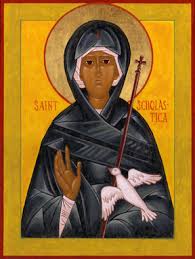
Scholastica

Scholastica of Nursia, Monastic, 543

The Collect:

Assist us, O God, to love one another as sisters and brothers, and to balance discipline with love and rules with compassion, according to the example shown by your servant Scholastica; for the sake of your Son Jesus Christ our Lord, to whom with you and the Holy Spirit be all honor and glory, now and for ever. Amen.

Scholastica (c. 480 – 10 February 543) is a saint of the Roman Catholic Church and the Eastern Orthodox Churches. She is the foundress of the women's branch of Benedictine Monasticism.

According to the Dialogues of Gregory the Great, Scholastica was born c. 480 in Nursia, Umbria, of wealthy parents. While Gregory states that Scholastica was Benedict's sister, a later tradition, says she was his twin. Whether this is meant biologically or allegorically (spiritually) or both is not clear. Gregory the Great says she was dedicated to God from a young age. She and her brother Benedict were brought up together until the time he left to pursue studies in Rome.

Benedictine tradition holds that Scholastica established a hermitage about five miles from Monte Cassino and that this was the first "Benedictine" convent.

The most commonly told story about her is that she would, once a year, go and visit her brother at a place near his abbey, and they would spend the day worshiping together and discussing sacred texts and issues.

One day they had supper and continued their conversation. When Benedict indicated it was time for him to leave, perhaps sensing the time of her death was drawing near, Scholastica asked him to stay with her for the evening so they could continue their discussions. Not wishing to break his own Rule, Benedict refused, insisting that he needed to return to his cell. At that point, Scholastica closed her hands in prayer, and after a moment, a wild storm started outside of the guest house in which they were housed. Benedict asked, "What have you done?", to which she replied, "I asked you and you would not listen; so I asked my God and he did listen. So now go off, if you can, leave me and return to your monastery." Benedict was unable to return to his monastery, and they spent the night in discussion.

Three days later, from his cell, he saw his sister's soul leaving the earth and ascending to heaven in the form of a shining white dove. Benedict had her body brought to his monastery, where he caused it to be laid in the tomb which he had prepared for himself. *

* The Lectionary, via Wikipedia, http://www.satucket.com/lectionary/scholastica.html

Wednesday, February 9, 2022

Valentine


Saint Valentine,
Priest and Martyr, circa 269 C.E.

Because St. Valentine is not officially on the Episcopal Church’s Calendar or that of the Roman Catholic Church, and as a “public service” announcement, and reminder for forgetful lovers that Valentine’s Day is next Monday - Today, we will learn a bit more about the uncertain history of this 3rd century martyr.

Join us today, Wednesday, February 9 at 12:10 p.m. for Holy Eucharist at the church, or tonight on Zoom for Evening Prayer and our Video Study Class.

Zoom Evening Prayer & Video Study Class

Wednesday, 5:30 p.m.

Join Zoom Meeting
https://us02web.zoom.us/j/86781577595?pwd=VjNnZTZnUFFadkJPc3VOVTh3K21Idz09
Meeting ID: 867 8157 7595
Passcode: 530
Dial by your location +1 312 626 6799 or +1 346 248 779

More information about St. Valentine from Encyclopedia Britannica Online follows:

St. Valentine, (died 3rd century, Rome; feast day February 14), name of one or two legendary Christian martyrs whose lives seem to be historically based. Although the Roman Catholic Church continues to recognize St. Valentine as a saint of the church, he was removed from the General Roman Calendar in 1969 because of the lack of reliable information about him. He is the patron saint of lovers, epileptics, and beekeepers.

By some accounts, St. Valentine was a Roman Catholic priest and physician who suffered martyrdom during the persecution of Christians by the emperor Claudius II Gothicus about 270. He was buried on the Via Flaminia, and Pope Julius I reportedly built a basilica over his grave. Other narratives identify him as the bishop of Terni, Italy, who was martyred, apparently also in Rome, and whose relics were later taken to Terni. It is possible these are different versions of the same original account and refer to only one person.

According to legend, St. Valentine signed a letter “from your Valentine” to his jailer’s daughter, whom he had befriended and healed from blindness. Another common legend states that he defied the emperor’s orders and secretly married couples to spare the husbands from war. *

* Britannica, The Editors of Encyclopedia. "St. Valentine". Encyclopedia Britannica, 5 Jan. 2021, https://www.britannica.com/biography/Saint-Valentine


Tuesday, February 8, 2022

Bakhita

Bakhita (Josephine Margaret Bakhita), Monastic, 1947

The Collect:

O God of Love, you delivered your servant Josephine Margaret Bakhita from the bondage of slavery to serve you in true freedom; by her example help us to see those enslaved among us, and work to release them from their chains. In your mercy, give to all survivors healing from their wounds and joy in their liberation; through Jesus Christ our Lord. Amen.

Josephine Margaret Bakhita, F.D.C.C., (ca. 1869 – 8 February 1947) was a Sudanese-Italian Canossian religious sister active in Italy for 45 years, after having been in a slave in Sudan.

She was born around 1869 in Darfur (now in western Sudan) in the village of Olgossa. Her respected and reasonably prosperous father was brother of the village chief. She was surrounded by a loving family of three brothers and three sisters.

Sometime between the age of seven to nine, probably in February 1877, she was seized by Arab slave traders, who had abducted her elder sister two years earlier. She was forced to walk barefoot about 960 kilometres (600 mi) to El Obeid and was sold and bought twice before she arrived there. Over the course of twelve years (1877–1889) she was sold three more times and then given away.

Bakhita was not the name she received from her parents at birth. It is said that the trauma of her abduction caused her to forget her own name; she took one given to her by the slavers, bakhita, Arabic for "lucky" or "fortunate".

In El Obeid, Bakhita was bought by a rich Arab who used her as a maid for his two daughters. They liked her and treated her well. Her fourth owner was a Turkish general, and she had to serve his mother-in-law and his wife, who were cruel to their slaves.

By the end of 1882, El Obeid came under the threat of an attack of Mahdist revolutionaries. The Turkish general began making preparations to return to his homeland and sold his slaves. In 1883 Bakhita was bought in Khartoum by the Italian Vice Consul Callisto Legnani, who treated her kindly and did not beat or punish her. Two years later, they escaped from besieged Khartoum and travelled to Suakin, which was the largest port of Sudan. In March 1885 they left Suakin for Italy and, once there, Legnani gave ownership of Bakhita to Signora Maria Turina Michieli. Turina Michieli. Bakhita's new owners took her to their family villa at Zianigo, near Mirano, Veneto.

When her owners went back to Sudan, Bakhita, on 29 November 1888, was left in the care of the Canossian Sisters in Venice. There, cared for and instructed by the Sisters, Bakhita encountered Christianity for the first time.

On 29 November 1889 an Italian court ruled that Bakhita had never legally been a slave. She chose to remain with the Canossians, and, on 9 January 1890, was baptized with the names of Josephine Margaret and Fortunata (which is the Latin translation for the Arabic Bakhita).

On 7 December 1893 Josephine Bakhita entered the novitiate of the Canossian Sisters and on 8 December 1896 she took her vows.

During her 42 years in Schio, Bakhita was employed as the cook, sacristan and portress (door keeper) and was in frequent contact with the local community. Her gentleness, calming voice, and ever-present smile became well known. Her special charisma and reputation for sanctity were noticed by her order; the first publication of her story (Storia Meravigliosa by Ida Zanolini) in 1931, made her famous throughout Italy.

Her last years were marked by pain and sickness. She used a wheelchair but she retained her cheerfulness. Bakhita died on 8 February 1947. For three days her body lay on display while thousands of people arrived to pay their respects.

Bakhita's legacy is that transformation is possible through suffering. Her story of deliverance from physical slavery also symbolises all those who find meaning and inspiration in her life for their own deliverance from spiritual slavery. She is venerated as a modern African saint, and as a statement against the brutal history of slavery. She has been adopted as the patron saint of Sudan and human trafficking survivors. *

The Lectionary, via Wikipedia, http://www.satucket.com/lectionary/Bakhita.html
Monday, February 7, 2022

A Prayer for Today


A Prayer for the Winter Olympic Games


Eternal God,
Giver of joy and source of all strength, we pray for those
who attend and compete in the Beijing Winter Olympic Games.
For the competitors and their loved ones,
For the many thousands who will support them,
And for the Churches and others who are praying for the people from many nations.
In a world where many are rejected and abused, we pray for a spirit
of tolerance and acceptance, of humility and respect
and for the health and safety of all.
May we at the last be led towards the love of Christ who is more than gold, today and forever. Amen.


Saturday, February 5, 2022

Agatha of Sicily

Agatha of Sicily, Martyr, 251

The Collect:

Almighty and everlasting God, who strengthened your martyr Agatha with constancy and courage: Grant us for the love of you to make no peace with oppression, to fear no adversity, and to have no tolerance for those who would use their power to abuse or exploit; Through Jesus Christ our Lord, to whom with you and the Holy Spirit be all honor and glory, now and for ever. Amen.

Saint Agatha of Sicily (c. 231 – c. 251 AD) is a Christian saint and virgin martyr. She was born at Catania or Palermo, Sicily, and she was martyred in approximately 251. She is the patron saint of breast cancer patients, martyrs, and wet nurses, among others.

One of the most highly venerated virgin martyrs of Christian antiquity, Agatha was put to death during the persecution of Decius (250–253) in Catania, Sicily, for her determined profession of faith.

Her written legend comprises "straightforward accounts of interrogation, torture, resistance, and triumph which constitute some of the earliest hagiographic literature".

According to the 13th-century Golden Legend, fifteen-year-old Agatha, from a rich and noble family, made a vow of virginity and rejected the amorous advances of the low-born Roman prefect Quintianus, who thought he could force her to turn away from her vow and force her to marry. His persistent proposals were consistently spurned by Agatha, so Quintianus, knowing she was a Christian during the persecution of Decius, had her arrested and brought before the judge. He was the judge.

He expected her to give in to his demands when she was faced with torture and possible death, but she simply reaffirmed her belief in God. To force her to change her mind, Quintianus sent Agatha to Aphrodisia, the keeper of a brothel, and had her imprisoned there, where she suffered a month of rape, assault, and efforts to get her to abandon her vow to God and go against her virtue.

Quintianus sent for her again, argued, threatened, and finally had her put in prison and had her tortured. Amongst the tortures she underwent was the cutting off of her breasts with pincers. After further dramatic confrontations with Quintianus, Agatha was then sentenced to be burnt at the stake, but an earthquake saved her from that fate; instead, she was sent to prison where St. Peter the Apostle appeared to her and healed her wounds.

Saint Agatha died in prison, probably in the year 251 according to the Legenda Aurea. Although the martyrdom of Saint Agatha is authenticated, and her veneration as a saint had spread beyond her native place even in antiquity, there is no reliable information concerning the details of her death. *

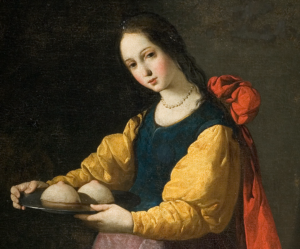
* The Lectionary, via Wikipedia, http://satucket.com/lectionary/Agatha_Sicily.html Note: Saint Agatha is often depicted iconographically carrying her excised breasts on a platter. For lots more info and to see more art - some very graphic - along with the tradition of making breast shaped pastry on the feast of St. Agatha which are found in many countries - see https://en.wikipedia.org/wiki/Agatha_of_Sicily