Wednesday, March 2, 2022

Ash Wednesday

Ash Wednesday

The first of the forty days of Lent, named for the custom of placing blessed ashes on the foreheads of worshipers at Ash Wednesday services. The ashes are a sign of penitence and a reminder of mortality, and may be imposed with the sign of the cross. Ash Wednesday is observed as a fast in the church year of the Episcopal Church. The Ash Wednesday service is one of the Proper Liturgies for Special Days in the BCP (p. 264). Imposition of ashes at the Ash Wednesday service is optional. *

* From An Episcopal Dictionary of the Church, Glossary definitions provided courtesy of Church Publishing Incorporated, New York, NY,(All Rights reserved) from “An Episcopal Dictionary of the Church, A User Friendly Reference for Episcopalians,” Don S. Armentrout and Robert Boak Slocum, editors. See https://www.episcopalchurch.org/glossary/  Note: Even though the imposition of ashes at the Ash Wednesday service is optional, Holy Eucharist will be celebrated at all our local Episcopal churches today.

Ash Wednesday Liturgy and Holy Eucharist at 12:00 Noon and 6:00 p.m.

Tuesday, March 1, 2022

From Our Friends at Grace


Eucharists and Suppers 2022


Eucharists and Suppers 2022 – All are invited!
Monroe, West Monroe, Ruston and Grambling Episcopal Churches 
Each Wednesday Lenten Eucharist will begin at 6:00 p.m.
and is followed by a simple Lenten supper.

March 9 - Grace Episcopal Church
 405 Glenmar Avenue, Monroe 
Presiding: The Rev’d Don Smith, Preaching: The Rev’d Rita Jefferson

March 16 - Church of the Redeemer, Ruston, (& St. Luke’s Chapel, Grambling)
504 Tech Drive, Ruston
Presiding: The Rev’d Frank Hughes, Preaching:  The Rev’d Don Smith
March 23 - St. Patrick’s Episcopal Church, West Monroe
1712 Wellerman Drive, West Monroe
Presiding: The Rev’d Rob Harkness, Preaching: The Rev’d Wayne Fletcher

March 30 - St. Thomas’ Episcopal Church
3706 Bon Aire Drive, Monroe
Presiding: The Rev’d Rita Jefferson, Preaching: The Rev’d Rob Harkness

April 6 - St. Alban’s Episcopal Church & 
Iglesia Episcopal La Esperanza de Familias Unidas
2816 Deborah Drive, Monroe  - Bi-lingual Eucharist and Sermon 
Presiding: The Rev’d Whit Stodghill, Preaching: The Rev’d Bette Jo Kauffman

April 13 - WEDNESDAY IN HOLY WEEK – Everybody Home
(No Supper)

April 16 - HOLY SATURDAY – The Great Vigil of Easter 
Grace Episcopal Church  – 8:00 p.m. (No Supper)
Presiding: The Rev’d Don Smith, Preaching:  Dean Dawnell Stodghill

Spread the Love


Our 2022 Lenten Project is the "Spread the Love" Peanut Butter Drive.

Why Peanut Butter?

Peanut butter is fun and nutritious!  Peanut butter is an excellent source of protein and serves as a great substitution or alternative to meat products because it is much less expensive, it is filling, and it contains fiber. Finally, peanut butter is jam-packed with nutrients like phosphorus, potassium, zinc, folate, and the antioxidant vitamin E and is easy to keep and store. Peanut butter is a popular food bank item and is always in high demand!

We will collect jars of peanut butter - any size or brand - from Ash Wednesday until Easter 2022 and all our collections will go to the Foodbank of NELA. Please be generous and help us "Spread the Love!"

Vincent Van Gogh and the Beauty of Lent

This year, for our Lenten Study, we will use "Vincent Van Gogh and the Beauty of Lent" resources from the SALT Project (saltproject.org). 

You can get a physical copy of the booklet at church, or you may use the digital copy of the booklet (which you can receive via email). Links to all the art are hyperlinked in the digital version and available on a separate "Van Gogh Links" sheet in pdf. 

Thy Kingdom Come

This idea is a metaphor of what Jesus' ministry is like and how God's Kingdom breaks into our world. 


This Lent, let us set about the task of making the world more like the Kingdom.

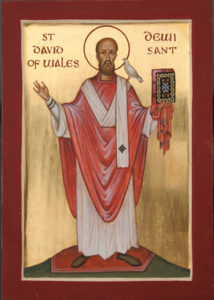
David of Wales

David of Wales, Bishop, c. 544

The Collect:

Almighty God, who called your servant David to be a faithful and wise steward of your mysteries for the people of Wales: Mercifully grant that, following his purity of life and zeal for the Gospel of Christ, we may, with him, praise you both here on earth and also in your everlasting kingdom; through Jesus Christ our Lord, who lives and reigns with you and the Holy Spirit, one God, for ever and ever. Amen.

When the pagan Anglo-Saxons invaded Britain in the fifth and sixth centuries, many British Christians sought refuge in the hill country of Wales. There they developed a style of Christian life devoted to learning, asceticism, and missionary fervor. Since there were no cities, the centers of culture were the monasteries, and most abbots were bishops as well. Dewi (David in English) was the founder, abbot, and bishop of the monastery of Mynyw (Menevia in English) in Pembrokeshire. He was responsible for much of the spread of Christianity in Wales, and his monastery was sought out by many scholars from Ireland and elsewhere. He is commonly accounted the apostle of Wales, as Patrick is of Ireland. His tomb is in St. David's cathedral, on the site of ancient Mynyw, now called Ty-Dewi (House of David).

Statue of St. David, at St. David's CathedralThe ancient custom in Wales, as throughout Celtic Christendom, was to have bishops who were abbots of monasteries, and who had no clear territorial jurisdiction, simply traveling about as they were needed. Eventually, however, the bishops of Bangor, Llandaff, St. Asaph, and St. Davids became the heads of four territorial dioceses, to which the diocese of Monmouth and the diocese of Swansea and Brecon have been added in this century.

For many centuries the Church in Wales had closer ties with the Celtic Churches in Scotland, Ireland, and Brittany than with the Church in Anglo-Saxon England. However, after the Norman conquest of Britain (1066 and after), the Anglo-Norman Kings began to contemplate the conquest of Wales. William the Conqueror began with the subjugation of South Wales as far as Carmathen, but the Welsh uplands remained independent far longer, and the conquest was not complete until about 1300, under Edward I. But eventually all of Wales came under English control, and the Church in Wales was placed under the jurisdiction of Canterbury, and thus became identified in the minds of many with the English supremacy. In 1920 the Church in Wales (Eglwys yng Nghymru) became independent of outside jurisdiction (though still in communion with other Anglican Churches, in England and elsewhere) and clear of all ties with the government. It is bilingual and active in the preservation of the Welsh language and culture.

 The Lectionary, James Kiefer, http://www.satucket.com/lectionary/David.htm