Thursday, February 24, 2022

Saint Matthias

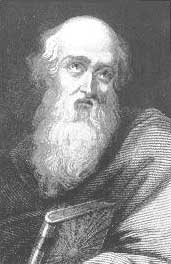
Saint Matthias the Apostle

The Collect:

Almighty God, who in the place of Judas chose your faithful servant Matthias to be numbered among the Twelve: Grant that your Church, being delivered from false apostles, may always be guided and governed by faithful and true pastors; through Jesus Christ our Lord, who lives and reigns with you, in the unity of the Holy Spirit, one God, now and for ever. Amen.

After the Ascension of Our Lord, His followers at Jerusalem chose a replacement for Judas. The man chosen was Matthias, "and he was numbered with the Eleven." Apart from the information given in the first chapter of Acts, nothing is known of him. It would be a mistake to conclude from this that he was a failure and a bad choice as an apostle. We know as much as we do about Peter and Paul because Luke (a traveling companion of Paul) wrote extensively about them. About most of the other apostles (those belonging to the original twelve and later ones like Matthias) we know little after Pentecost on an individual basis.*

* The Lectionary,  James Kiefer, http://www.satucket.com/lectionary/Matthias.htm

Wednesday, February 23, 2022

Polycarp of Smyrna

Polycarp of Smyrna, Bishop and Martyr, 156

Today, the church remembers Polycarp of Smyrna, Bishop and Martyr. Join us for Holy Eucharist today at 12:10 p.m. at St. Alban’s, or for Zoom Evening Prayer at 5:30 p.m. to learn more about his life and work.

Holy Eucharist - Wednesday, 12:10 p.m.

Zoom Evening Prayer & Video Study - Wednesday, 5:30 p.m.

Join Zoom Evening Prayer
https://us02web.zoom.us/j/86781577595?pwd=VjNnZTZnUFFadkJPc3VOVTh3K21Idz09
Meeting ID: 867 8157 7595
Passcode: 530
Dial by your location +1 312 626 6799 or +1 346 248 779

The Collect:


O God, the maker of heaven and earth, you gave your venerable servant, the holy and gentle Polycarp, the boldness to confess Jesus Christ as King and Savior and the steadfastness to die for his faith: Give us grace, following his example, to share the cup of Christ and to rise to eternal life; through Jesus Christ our Lord, who lives and reigns with you and the Holy Spirit, one God, now and for ever. Amen.

Polycarp was Bishop of Smyrna (today known as Izmir), a city on the west coast of Turkey. The letters to the "seven churches in Asia" at the beginning of the book of Revelation include a letter to the church in Smyrna, identifying it as a church undergoing persecution.

Polycarp is said to have known the Apostle John, and to have been instructed by him in the Christian faith. Polycarp, in his turn, was known to Irenaeus, who later became Bishop of Lyons in what is now France. We have (1) Irenaeus's brief memoir of Polycarp; (2) a letter to Polycarp from Ignatius of Antioch, written around 115 AD when Ignatius was passing through Turkey, being sent in chains to Rome to be put to death; (3) a letter from Polycarp to the church at Philippi, written at the same time; and (4) an account of the arrest, trial, conviction, and martyrdom of Polycarp, written after his death by one or more members of his congregation.

Polycarp was denounced to the government, arrested, and tried on the charge of being a Christian. When the proconsul urged him to save his life by cursing Christ, he replied: "Eighty-six years I have served him, and he never did me any wrong. How can I blaspheme my King who saved me?" The magistrate was reluctant to kill a a gentle old man, but he had no choice.

Polycarp was sentenced to be burned. As he waited for the fire to be lighted, he prayed:

Lord God Almighty, Father of your blessed and beloved child Jesus Christ, through whom we have received knowledge of you, God of angels and hosts and all creation, and of the whole race of the upright who live in your presence: I bless you that you have thought me worthy of this day and hour, to be numbered among the martyrs and share in the cup of Christ, for resurrection to eternal life, for soul and body in the incorruptibility of the Holy Spirit. Among them may I be accepted before you today, as a rich and acceptable sacrifice, just as you, the faithful and true God, have prepared and foreshown and brought about. For this reason and for all things I praise you, I bless you, I glorify you, through the eternal heavenly high priest Jesus Christ, your beloved child, through whom be glory to you, with him and the Holy Spirit, now and for the ages to come. Amen.

The fire was then lit and shortly thereafter a soldier stabbed Polycarp to death by order of the magistrate. His friends gave his remains honorable burial, and wrote an account of his death to other churches. See the Penguin volume, Ancient Christian Writers. *

* The Lectionary, James Kiefer, http://www.satucket.com/lectionary/Polycarp.htm

Tuesday, February 22, 2022

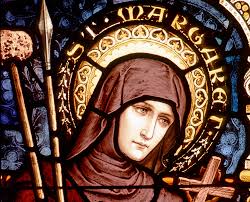
Margaret of Cortona

Margaret of Cortona, Monastic, 1297

The Collect:

Grant, O God, to all your people, as to your servant Margaret of Cortona, the spirit of repentance and supplication, that we might seek and desire nothing in this transitory life above you; through Jesus Christ our Lord. Amen.

Margaret of Cortona, (1247 – 22 February 1297) was an Italian penitent of the Third Order of St. Francis ("T.O.S.F."). She was born in Laviano, near Perugia, and died in Cortona. She was canonized in 1728.

Margaret was born of farming parents in Laviano. As she grew older, Margaret became more willful and reckless. At the age of 17 she met a young man, and she ran away with him. Soon Margaret found herself installed in the castle, not as her master's wife, for convention would never allow that, but as his mistress. For ten years, she lived with him near Montepulciano and bore him a son.

When her lover failed to return home from a journey one day, Margaret became concerned. The unaccompanied return of his favorite hound alarmed Margaret, and the hound led her into the forest to his murdered body. That crime shocked Margaret into a life of prayer and penance.Margaret returned to his family all the gifts he had given her and left his home. With her child, she returned to her father's house, but her stepmother would not have her. Margaret and her son then went to the Franciscan friars at Cortona, where her son eventually became a friar. She fasted, avoided meat, and subsisted on bread and vegetables.

In 1277, after three years of probation, Saint Margaret joined the Third Order of Saint Francis and chose to live in poverty. She pursued a life of prayer and penance at Cortona, and there established a hospital for the sick, homeless and impoverished.

Twice, following divine command, she challenged the Bishop of Arezzo, Guglielmo Ubertini Pazzi, in whose diocese Cortona lay, because he lived and warred like a prince. She moved to the ruined Church of St Basil, now Santa Margherita, and spent her remaining years there; she died on 22 February 1297. *

 * The Lectionary, via Wikipedia, http://www.satucket.com/lectionary/Margaret_Cortona.html 


Monday, February 21, 2022

Saturday, February 19, 2022

Agnes Tsao Kou Ying, Agatha Lin Zhao, and Lucy Yi Zhenmei

Agnes Tsao Kou Ying, 1856, Agatha Lin Zhao, 1858, and Lucy Yi Zhenmei, 1862, Catechists and Martyrs


The Collect:

Lord Jesus Christ, who willingly walked the way of the cross: Strengthen your church through the witness of your servants Agnes Tsao Kou Ying, Agatha Lin Zhao, and Lucy Yi Zhenmei to hold fast to the path of discipleship even unto death; for with the Father and Holy Spirit you live and reign, one God, for ever and ever. Amen.

Agnes Tsao Kou Ying, Agatha Lin Zhao, & Lucy Yi Zhenmei are three Roman Catholic nineteenth-century martyrs. They were all canonized by Pope John Paul II on 1 October 2000.

Agnes Tsao Kou Ying (1821 – 1 March 1856 was a Chinese layperson who was martyred for preaching the Gospel to the Chinese in Guangxi.

Her family was a traditional Catholic family originally from Sichuan Province. When Agnes became eighteen, she married a local farmer, but her brother- and sister-in-law treated her as an outsider (for she was Christian) and did not consider her a part of the family. Therefore, Agnes was left with little to eat. Things became worse for Agnes when her husband died after two years and she was driven out of the house.

One day, when Fr. Ma (Auguste Chapdelaine) was in town, he discovered how well Agnes knew the faith and asked her to move to Guangxi Province for some missionary work, especially for teaching the Catholic faith to some 30-40 Catholic families living there. She also taught cooking and household management.

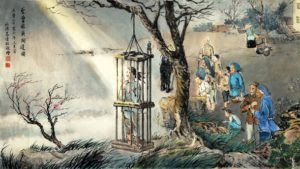
In 1856, when she was helping out in Yaoshan, Guangxi (near present-day Guilin, Guizhou), the local government decided to take some measures against the Christians living in that area. Agnes was taken into custody along with many other Catholics who were soon released; only Agnes and Father Ma had to stay in prison. Father Ma later died in prison. The county magistrate tried to persuade Agnes to deny her faith under the promise that if she did, she would be released. However, Agnes was unmoved. Then the magistrate threatened torture, but she showed no fear. Finally, on January 22, the magistrate decided on her punishment. He had her locked in a cage so small that she could only stand up, but her spirit never failed. She prayed repeatedly, "God, have mercy on me; Jesus save me!" She died three days later.

Agatha Lin Zhao also was born into a Catholic family, in 1817. She became a school teacher in Mao-ken, Langdai, Guizhou, but was arrested for her faith. She refused to renounce Christianity and was beheaded on Jan. 28, 1858.

She should not be confused with Lin Zhou, a Chinese Christian who was executed in 1968 during China's Cultural Revolution.

Lucy Yi Zhenmei (December 9, 1815 - February 19, 1862) was a Chinese Roman Catholic saint from Mianyang in Sichuan.

As she matured she developed a love for reading and study. At age 20, in the midst of her higher education she grew very ill. After her recovery Lucy took her spiritual life still more seriously. She devoted herself to the discipline of prayer with great devotion, assuming a way of life much like that of a religious while continuing to assist in the support of her family.

After her father died, she lived with her brother and mother, using part of her leisure time to teach the faith to children nearby. The parish priest, who asked her to teach at the school in Mianyang, noticed her devotion and reliable knowledge of her faith. Full of enthusiasm for spreading the Gospel, she went on doing missionary work. However, for her own safety she decided to stay at the convent of lay virgins.

In 1862, she went with Fr. Wen Nair to open a mission in Jiashanlong, but just then the administrator of Guizhou Province, began to stir up hatred against Christians, which the local magistrate supported. As a result, Father Wen and several others were all imprisoned and sentenced to death without a formal trial. On February 18, the day of their execution, they met Yi Zhenmei on the road. She was also jailed and put on trial that very day and sentenced to death, because she refused to renounce her faith. The following day at noon, February 19, 1862, she was beheaded. Brave believers took the bodies of all five martyrs to the Liuchonnguan seminary grounds for burial. *

* The Lectionary, via Wikipedia, http://www.satucket.com/lectionary/Chinese_Martyrs.html

Friday, February 18, 2022

This Sunday, February 20


Sunday, February 20, 2022

Join us for “at church” or “virtually” for worship this Sunday, February 20, The Seventh Sunday after the Epiphany, at St. Alban’s, St. Thomas’, St. Patrick’s, and Iglesia Episcopal La Esperanza de Familias Unidas. Remember - Masks are optional, and communion will be offered in both kinds- wine by intinction. We strongly urge everyone to get vaccinated. Please maintain social distance in non-family groups.

Holy Eucharist, Rite Two
St. Alban’s - 8:30 a.m. and 10:30 a.m.* 
Remember that on February 27, The Last Sunday after the Epiphany, Bishop Jake will visit St. Alban’s and Iglesia Episcopal La Esperanza de Familias Unidas
St. Thomas' - 10:00 a.m.*
St. Patrick’s – 11:00 a.m.*

* These liturgies will be Live-Streamed on Facebook for those who choose to remain at home. Download a pdf of the leaflet to print or to use on your phone or tablet with this link -   https://drive.google.com/file/d/1NZShBTG6fe7q4_5wnRCFvPebAO2JyUI_/view?usp=sharing                

Oración de la tarde diaria a través de Zoom
Iglesia Episcopal La Esperanza de Familias Unidas – Domingo - 5:00 p.m.
Recuerde que nos uniremos a St. Alban's a las 10:30 a.m. de la mañana del 27 de febrero, el próximo domingo, para la visita del obispo Jake. También tendremos un bautismo ese día.
Oración Vespertina Diaria a través de Zoom - Únete aqui
https://us02web.zoom.us/j/89906444437?pwd=bmdXYW9kNjVicVJHU3Fkb3BrMitKZz09
ID de reunión: 899 0644 4437
Contraseña: 500
o llame al +1 312 626 6799 or  +1 346 248 7799

Zoom Compline - All Welcome 
Sunday -  8:00 p.m. 

Join Zoom Meeting
https://us02web.zoom.us/j/83861688528?pwd=WFdBcndxV3hzbUpETDNTSFFzc3Z0QT09 
Meeting ID: 838 6168 8528
Passcode: 800
or dial in at  +1 312 626 6799 or +1 346 248 7799

We hope to “see” you all on Sunday as you are most comfortable!

Rita+, Rob+ and Whit+

Art from Clip Art, Steve Erspamer, Liturgy Training Publications – ltp.org

Martin Luther

Martin Luther, Pastor and Reformer, 1546

The Collect:

O God, our refuge and our strength, who raised up your servant Martin Luther to reform and renew your church in the light of your word: Defend and purify the church in our own day and grant that, through faith, we may boldly proclaim the riches of your grace, which you have made known in Jesus Christ our Savior, who with you and the Holy Spirit, lives and reigns, one God, now and for ever. Amen.

Martin Luther was born November 10, 1483, at Eisleben, in Germany. His intellectual abilities were evident early, and his father planned a career for him in law. Luther’s real interest lay elsewhere, however, and in 1505, he entered the local Augustinian monastery. He was ordained a priest on April 3, 1507.

In October 1512, Luther received his doctorate in theology, and shortly afterward he was installed as a professor of biblical studies at the University of Wittenberg. His lectures on the Bible were popular, and within a few years he made the university a center for biblical humanism. As a result of his theological and biblical studies, he called into question the practice of selling indulgences. On the eve of All Saints’ Day, October 31, 1517, he posted on the door of the castle church in Wittenberg the notice of an academic debate on indulgences, listing 95 theses for discussion. As the effects of the theses became evident, the Pope called upon the Augustinian order to discipline their member. After a series of meetings, political maneuvers, and attempts at reconciliation, Luther, at a meeting with the papal legate in 1518, refused to recant.

Luther was excommunicated on January 3, 1521. The Emperor Charles V summoned him to the meeting of the Imperial Diet at Worms. There Luther resisted all efforts to make him recant, insisting that he had to be proved in error on the basis of Scripture. The Diet passed an edict calling for the arrest of Luther. Luther’s own prince, the Elector Frederick of Saxony, however, had him spirited away and placed for safekeeping in his castle, the Wartburg.

There Luther translated the New Testament into German and began the translation of the Old Testament. He then turned his attention to the organization of worship and education. He introduced congregational singing of hymns, composing many himself, and issued model orders of services. He published his large and small catechisms for instruction in the faith. During the years from 1522 to his death, Luther wrote a prodigious quantity of books, letters, sermons, and tracts. Luther died at Eisleben on February 18, 1546. *

A Great Cloud of Witnesses - A Calendar of Commemorations, Church Publishing,
Copyright © 2016 by The Domestic and Foreign Missionary Society of The Protestant Episcopal Church in the United States of America, https://extranet.generalconvention.org/staff/files/download/19349