Thursday, February 17, 2022

Janani Luwum

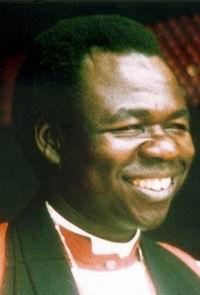
Janani Luwum, Archbishop and Martyr, 1977
The Collect:

O God, whose Son the Good Shepherd laid down his life for his sheep: We give you thanks for your faithful shepherd, Janani Luwum, who after his Savior’s example gave up his life for the sake of his flock. Grant us to be so inspired by his witness that we make no peace with oppression, but live as those who are sealed with the cross of Christ, who died and rose again, and now lives and reigns with you and the Holy Spirit, one God, for ever and ever. Amen.

Janani Luwum was born in 1922. His father was a convert to Christianity. Janani was sent to school and eventually became a schoolteacher. In 1948 he was converted. He became very active in the East African revival movement, and became a lay reader, then a deacon, and then a priest in 1956. He was chosen to study for a year at St Augustine's College in Canterbury, England. He returned to Uganda, worked as a parish priest, and then taught at Buwalasi Theological College. He made a second visit to Britain to study at the London College of Divinity, returning to Uganda to become Principal of Buwalasi. In 1969 he was consecrated bishop of Northern Uganda.

The Church in Uganda began with the deaths of martyrs (see Martyrs of Uganda, 3 June 1886, and James Hannington and his Companions, Martyrs, 29 October 1885). Around 1900, Uganda became a British protectorate, with the chief of the Buganda tribe as nominal ruler, and with several other tribes included in the protectorate. In 1962 Uganda became an independent country within the British Commonwealth, with the Bugandan chief as president and Milton Obote, of the Lango tribe, as Prime Minister. In 1966, Obote took full control of the government. In 1971, he was overthrown by General Idi Amin, Chief of Staff of the Armed Forces. Almost immediately, he began a policy of repression, arresting anyone suspected of not supporting him. Hundreds of soldiers from the Lango and Acholi tribes were shot down in their barracks. Amin ordered the expulsion of the Asian population of Uganda, about 55,000 persons, mostly small shopkeepers from India and Pakistan. Over the next few years, many Christians were killed for various offenses. A preacher who read over the radio a Psalm which mentioned Israel was shot for this in 1972.

In 1974 Janani Luwum he became Archbishop of Uganda, Rwanda, Burundi and Boga-Zaire. As we have seen, it was a time of widespread terror. Archbishop Luwum often went personally to the office of the dreaded State Research Bureau to help secure the release of prisoners.

Tension between Church and state worsened in 1976. Religious leaders, including Archbishop Luwum, jointly approached Idi Amin to share their concern. They were rebuffed. But Archbishop Luwum continued to attend Government functions. One of his critics accused him of being on the Government side and he replied: "I face daily being picked up by the soldiers. While the opportunity is there I preach the Gospel with all my might, and my conscience is clear before God that I have not sided with the present Government which is utterly self-seeking. I have been threatened many times. Whenever I have the opportunity I have told the President the things the churches disapprove of."

Early in 1977, there was a small army rebellion that was put down with only seven men dead. However, Amin determined to stamp out all traces of dissent. His men killed thousands, including the entire population of Milton Obote's home village. On Sunday, 30 January, Bishop Festo Kivengere preached on "The Preciousness of Life" to an audience including many high government officials. He denounced the arbitrary bloodletting, and accused the government of abusing the authority that God had entrusted to it. The government responded on the following Saturday (5 February) by an early (1:30am) raid on the home of the Archbishop, Janani Luwum, ostensibly to search for hidden stores of weapons.

The Archbishop called on President Amin to deliver a note of protest, signed by nearly all the bishops of Uganda, against the policies of arbitrary killings and the unexplained disappearances of many persons. Amin accused the Archbishop of treason, produced a document supposedly by former President Obote attesting his guilt, and had the Archbishop and two Cabinet members (both committed Christians) arrested and held for military trial.

On 16 February, the Archbishop and six bishops were tried on a charge of smuggling arms. Archbishop Luwum was not allowed to reply, but shook his head in denial. The President concluded by asking the crowd: "What shall we do with these traitors?" The soldiers replied "Kill him now". The Archbishop was separated from his bishops. As he was taken away Archbishop Luwum turned to his brother bishops and said: "Do not be afraid. I see God's hand in this."

The three (the Archbishop and the two Cabinet members) met briefly with four other prisoners who were awaiting execution, and were permitted to pray with them briefly. Then the three were placed in a Land Rover and not seen alive again by their friends. The government story is that one of the prisoners tried to seize control of the vehicle and that it was wrecked and the passengers killed. The story believed by the Archbishop's supporters is that he refused to sign a confession, was beaten and otherwise abused, and finally shot. His body was placed in a sealed coffin and sent to his native village for burial there. However, the villagers opened the coffin and discovered the bullet holes. In the capital city of Kampala a crowd of about 4,500 gathered for a memorial service beside the grave that had been prepared for him next to that of the martyred bishop Hannington. In Nairobi, the capital of nearby Kenya, about 10,000 gathered for another memorial service. Bishop Kivengere was informed that he was about to be arrested, and he and his family fled to Kenya, as did the widow and orphans of Archbishop Luwum.

The following June, about 25,000 Ugandans came to the capital to celebrate the centennial of the first preaching of the Gospel in their country, among the participants were many who had abandoned Christianity, but who had returned to their Faith as a result of seeing the courage of Archbishop Luwum and his companions in the face of death. *

*  The Lectionary, James Kiefer, http://www.satucket.com/lectionary/janani_luwum.htm

Wednesday, February 16, 2022

Souper Job!

Great job all! We donated $300 to Food Bank of Northeast Louisiana!


Charles Todd Quintard


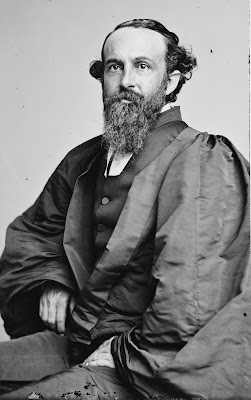
Charles Todd Quintard,
Bishop of Tennessee, 1898

It is uncertain whether the Church still lists Charles Todd Quintard as an official remembrance. He is listed both in Holy Women, Holy Men - Celebrating the Saints, Copyright © 2010 by The Church Pension Fund, and A Great Cloud of Witnesses, Copyright © 2016 by The Domestic and Foreign Missionary Society of The Protestant Episcopal Church in the United States of America, but Quintard is not on the most current Liturgical Calendar for The Episcopal Church, see - https://www.episcopalchurch.org/lectionary/ 

It is likely his involvement in the Civil War, and at the University of South has called his remembrance into question. The information below provides some of the history of his complex and paradoxical life. This serves as one more reminder of the difficulty we face as we remember and tell of our nation’s difficult history.

Join us for Holy Eucharist today at 12:10 p.m. at St. Alban’s, or for Zoom Evening Prayer at 5:30 p.m. to learn more.

Zoom Evening Prayer & Study
Wednesday, 5:30 p.m.

Join Zoom Meeting
https://us02web.zoom.us/j/86781577595?pwd=VjNnZTZnUFFadkJPc3VOVTh3K21Idz09
Meeting ID: 867 8157 7595
Passcode: 530
Dial by your location +1 312 626 6799 or +1 346 248 779

The Collect:

Mighty God, we bless your Name for the example of your bishop Charles Todd Quintard, who opposed the segregation of African Americans in separate congregations and condemned the exclusion of the poor; and we pray that your Church may be a refuge for all, for the honor of your Name; through Jesus Christ, who with you and the Holy Spirit lives and reigns, one God, for ever and ever. Amen.

Charles Todd Quintard was the second bishop of the Diocese of Tennessee and the first Vice Chancellor of The University of the South at Sewanee.

Quintard was born in 1824 in Stamford, Connecticut. In 1847 he received the degree of Doctor of Medicine from the Medical College of New York University and worked at New York City’s Bellevue Hospital. After a brief episode of practicing medicine in Athens, Georgia, Quintard became the professor of anatomy and physiology at Memphis Medical College and an editor of the Memphis Medical Reporter. In 1848, Quintard married Katherine Isabella Hand, a native of Roswell, Georgia, and together they were the parents of three children.

It was while he was in Memphis that Quintard came to know Bishop James Hervey Otey, the first bishop of Tennessee. Under Otey’s personal tutelage, Quintard prepared for holy orders. He was ordained to the diaconate on New Year’s Day, 1855, and to the priesthood on the Feast of the Epiphany, 1856. He served as rector of the Church of the Advent, Nashville, until his election as the second bishop of Tennessee in October 1865. He served as bishop until his death in 1898.

During the Civil War, Quintard played dual roles in the Confederate Army as both chaplain and surgeon. Following the war, he was instrumental in bringing together the previously divided factions and extending the reach of The Episcopal Church, particularly among African Americans.

Bishop Quintard was a strong advocate of education at every level and played a major role in the establishment of schools. Perhaps his greatest accomplishment was the rebuilding of The University of the South in Sewanee, Tennessee, after its destruction during the Civil War. He made several successful trips to England to raise the funds to secure the future of the University. From February 1867 to July 1872, Quintard served as the reconstituted University’s first Vice Chancellor. Quintard believed that a great Episcopal university was essential, not just to the church in Tennessee and the southeast, but to the whole church, and thus devoted much of his ministry to Sewanee. *

Holy Women, Holy Men - Celebrating the Saints, Copyright © 2010 by The Church Pension Fund - see https://diobeth.typepad.com/files/holy-women-holy-men.pdf


Tuesday, February 15, 2022

Thomas Bray

Thomas Bray, Priest and Missionary, 1730

The Collect:

O God of compassion, who opened the heart of your servant Thomas Bray to answer the needs of the church in the New World: Make your church diligent at all times to propagate the Gospel, and to promote the spread of Christian knowledge; through Jesus Christ our Lord, who lives and reigns with you and the Holy Spirit, one God, for ever and ever. Amen.

In 1696 Thomas Bray, an English country parson, was commissioned to report on the condition of the Church in the colony of Maryland. He spent only ten weeks in the colony, but he radically re-organized and renewed the Church there, providing for the instruction of children and the systematic examination of candidates for pastoral positions. He founded thirty-nine lending libraries and numerous schools. Both in Maryland and upon his return to England, he wrote and preached in defense of the rights of enslaved Africans, and of Indians deprived of their land. Back in England, he worked for the reform of prison conditions, and for the establishment of preaching missions to prisoners. He persuaded General Oglethorpe to found an American colony (Georgia) for the settlement of debtors as an alternative to debtors' prison. He founded a missionary society, the SPG (Society for the Propagation of the Gospel) and an educational and publishing society, the SPCK (Society for Promoting Christian Knowledge), both of which are still active today. *

* The Lectionary, James Kiefer, http://satucket.com/lectionary/Thomas_Bray.htm

Monday, February 14, 2022

Cyril and Methodius

Cyril and Methodius, Missionaries, 869, 885

The Collect:

Almighty and everlasting God, who by the power of the Holy Spirit moved your servants Cyril and Methodius to bring the light of the Gospel to a hostile and divided people: Overcome all bitterness and strife among us by the love of Christ, and make us one united family under the banner of the Prince of Peace; who lives and reigns with you and the Holy Spirit, one God, now and for ever. Amen.

Cyril (originally Constantine) and Methodius were brothers, from a noble family in Thessalonika, a district in northeastern Greece. Constantine was the younger, born in about 827, and his brother Methodius in about 825.  They both entered the priesthood. Constantine undertook a mission to the Arabs, and then became a professor of philosophy at the imperial school in Constantinople and librarian at the cathedral of Santa Sophia. Methodius became governor of a district that had been settled by Slavs. Both brothers then retired to monastic life. In about 861, the Emperor Michel III sent them to work with the Khazars northeast of the Black Sea in the Dnieper-Volga region of what was later Russia. They learned the Khazar language and made many converts, and discovered what were believed to be relics of Clement, an early Bishop of Rome.

In about 863, Prince Rotislav, the ruler of Great Moravia (an area including much of what was later Czechoslovakia), asked the emperor for missionaries, specifying that he wanted someone who would teach his people in their own language (he had western missionaries, but they used only Latin). The emperor and the Patriarch Photius sent Methodius and his brother Constantine, who translated the Liturgy and much of the Scriptures into Slavonic.

Since Slavonic had no written form, they invented an alphabet for it, the Glagolitic alphabet, which gave rise to the Cyrillic alphabet (named for Constantine aka Cyril), which is used to write Russian and (with modifications) several related languages today. They used the Greek alphabet as their basis, writing a letter in two forms when two similar sounds in Slavonic each needed a letter (hence, in modern Russian, we have "plain a" written "A" and "fancy a" written like a backward "R" representing the sounds of hard and soft (or unpalatalized and palatalized) a, represented approximately in English by "ah" and "yah"). When no Greek letter was close, then they borrowed from Hebrew (the letter TZADDI for the sound "ts" as in "tsar", and the letter SHIN for the sound "sh", and a variant on it for the sound "shch" as in "Khrushchev", and so on).  The resulting alphabet had 43 letters. It has since undergone development, chiefly simplification and the omission of letters. Thus, the modern Russian alphabet has only 32 letters. The Cyrillic alphabet with minor variations is used today for Russian, Ukrainian, and other languages of the former USSR, and also for Bulgarian and Serbian and formerly for Rumanian.  (Serbs and Croats both speak Serbo-Croatian, but the Serbs, who are traditionally East Orthodox, write it with the Cyrillic alphabet, while the Croats, who are traditionally Roman Catholic, write it with the Latin alphabet. Before the first World War, there were many muslims (regarded as Turks) living in Greece, and many Christians (regarded as Greeks) living in western Turkey. Each group spoke the language of the country in which it lived, but the Greek-speaking Turks in Greece wrote Greek using the Arabic script that was then standard for writing Turkish, and the Turkish-speaking Greeks in Turkey wrote Turkish in the Greek alphabet. For some reason, the alphabet matters to rival religious groups.)

Thus the brothers were the first to produce written material in the Slavic languages, and are regarded as the founders of Slavic literature.

The brothers encountered missionaries from Germany, representing the western or Latin branch of the Church, and more particularly representing the Holy Roman Empire as founded by Charlemagne, and committed to linguistic, and cultural uniformity. They insisted on the use of the Latin liturgy, and they regarded Moravia and the Slavic peoples as their rightful mission field. When friction developed, the brothers, unwilling to be a cause of dissension among Christians, went south toward Venice, and then from Venice to Rome to see the Pope, hoping to reach an agreement that would avoid quarreling between missionaries in the field. They brought with them the above-mentioned relics of Clement, third bishop of Rome after the Apostles (see 23 November). They arrived in Rome in 868 and were received with honor.  Constantine entered a monastery there, taking the name Cyril, by which he is now remembered. However, he died only a few weeks thereafter. He is buried in Rome in the Church of San Clemente.

The Pope (Adrian II) gave Methodius the title of Archbishop of Sirmium (now Sremska Mitrovica in Yugoslavia) and sent him back in 869, with jurisdiction over all of Moravia and Pannonia, and authorization to use the Slavonic Liturgy. Soon, however, Prince Rotislav, who had originally invited the brothers to Moravia, died, and his successor did not support Methodius. In 870 the Frankish king Louis and his bishops deposed Methodius at a synod at Ratisbon, and imprisoned him for a little over two years.  The pope (John VIII) secured his release, but told him not to use the Slavonic Liturgy any more. In 878 he was summoned to Rome on charges of heresy and using Slavonic. This time Pope John was convinced by his arguments and sent him back, cleared of all charges, and with permission to use Slavonic. He died 6 April 885 in Velehrad, the old capitol of Moravia. The Carolingian bishop who succeeded him, Wiching, suppressed the Slavonic Liturgy and forced the followers of Methodius into exile. Many found refuge with King Boris of Bulgaria (852-889), under whom they reorganized a Slavic-speaking Church. Meanwhile, Pope John's successors adopted a Latin-only policy which lasted for centuries.

Today Cyril and Methodius are honored by Eastern and  Western Christians alike, and the importance of their work in preaching and worshiping in the language of the people is recognized on all sides. *

* The Lectionary,  James Kiefer, http://www.satucket.com/lectionary/Cyril&Methodius.htm

Saturday, February 12, 2022

In the Morning


In the Morning - From Psalm 51


Open my lips, O Lord, *

    and my mouth shall proclaim your praise.

Create in me a clean heart, O God, *

    and renew a right spirit within me.

Cast me not away from your presence *

    and take not your Holy Spirit from me.

Give me the joy of your saving help again *

    and sustain me with your bountiful Spirit.

Glory to the Father, and to the Son, and to the Holy Spirit: *

    as it was in the beginning, is now, and will be for ever. Amen.


The Book of Common Prayer, page 137

Friday, February 11, 2022

Sunday, February 13


Sunday, February 13, 2022 - Souper Bowl Sunday

Join us for “at church” or “virtually” for worship this Sunday, February 13, The Sixth Sunday after the Epiphany, at St. Alban’s, St. Thomas’, St. Patrick’s, and Iglesia Episcopal La Esperanza de Familias Unidas. Remember - Masks are optional, and communion will be offered in both kinds- wine by intinction. We strongly urge everyone to get vaccinated. Please maintain social distance in non-family groups.

Holy Eucharist, Rite Two
St. Alban’s - 8:30 a.m. and 10:30 a.m.*
St. Thomas' - 10:00 a.m.*
St. Patrick’s – 11:00 a.m.*

* These liturgies will be Live-Streamed on Facebook for those who choose to remain at home. Download a pdf of the leaflet to print or to use on your phone or tablet with this link - https://drive.google.com/file/d/1NZShBTG6fe7q4_5wnRCFvPebAO2JyUI_/view?usp=sharing                


La Santa Eucaristía: Rito Dos en la iglesia (primer y tercer domingo del mes y transmitido en vivo en Facebook) o Oración de la tarde diaria a través de Zoom (los otros domingos del mes)

Iglesia Episcopal La Esperanza de Familias Unidas – Domingo - 5:00 p.m.

Oración Vespertina Diaria a través de Zoom - Únete aqui
https://us02web.zoom.us/j/89906444437?pwd=bmdXYW9kNjVicVJHU3Fkb3BrMitKZz09
ID de reunión: 899 0644 4437
Contraseña: 500
o llame al +1 312 626 6799 or  +1 346 248 7799


Zoom Compline - All Welcome 

Sunday -  8:00 p.m. WILL NOT BE READ - Enjoy the Super Bowl AND make a donation to the Souper Bowl at https://tacklehunger.org/ or in the Souper Bowl Pot at Church!


We hope to “see” you all on Sunday as you are most comfortable!

Rita+, Rob+ and Whit+

Art from Clip Art, Steve Erspamer, Liturgy Training Publications – ltp.org

A Souper Bowl long ago!